AMIRI Prices in 2026: What Every Category Costs
Each figure below is an observed market price, gathered from listings during 2026, and not one line of it is an official price list. There is no published public tariff, prices vary by season and by region, and currency conversion at multi-brand retailers moves the numbers once more. Read the numbers as a map of where each category sits relative to the others, then confirm the current figure on the product page before you commit. Structurally the range falls into three bands, an entry band built on jersey, a core band covering amiri jeans, hoodies and sneakers, and a top band of boots and worked outerwear. Beyond the bands, two things shape the real cost, a discount cycle far more aggressive than the positioning suggests and a secondary market that mostly sits below retail. Both get their own section below, since ignoring either leaves you with a badly wrong picture of what this label costs.
The entry band: tees, plus the figures nobody publishes
Jersey is where the range starts, and for most buyers a T-shirt is the first purchase. At authorised multi-brand retailers, observed listings place standard logo tees at roughly $425 to $460, and that is the realistic floor for a main-line piece. Graphics with heavy work, oversized cuts and long-sleeve constructions sit well above that, the most elaborate observed listings running into the $900s. If a current-season tee is advertised far below the low $400s, treat it as a question rather than a find. This guide has one gap worth naming outright, as entry amiri clothes price points for socks, caps, key chains and small leather goods were not documented in the sources checked. In the brand’s own accessories navigation those categories sit alongside bags, eyewear, scarves and gloves, but no reliable observed figures were captured for them, and inventing numbers to close the gap would be worse than leaving it open.
The core band: amiri jeans
Nothing sits closer to the centre of gravity than denim, and nothing prices more predictably. The Stack jean is the observed entry point into core denim at $750, a skinny cut with an intentional overdye and a long inseam. The signature MX1 is observed at $1,090, the highest-profile figure in the whole range, and the price reflects hand-distressing plus repair with pleated ovine leather. A motocross-inspired hybrid with a no-waistband construction, the women’s Baggy MX3 is observed at $990. Around those anchors, other cuts are listed by authorised retailers across roughly $700 to $1,100, while heavily worked pieces such as crystal-embellished and reconstructed denim sit above the standard band. Both core styles are made in the United States, and that is part of why the denim prices where it does.
The amiri hoodie within the core band
The second pillar of the core band is hoodies, where the spread inside the category runs wider than most buyers expect. A cotton hooded sweatshirt with a kangaroo pocket, the MA Core Logo Hoodie is observed at $650 and acts as the reference point for the category. At authorised retailers the wider hoodie line shows observed listings running to roughly $950, with the heaviest constructions sitting above that. The difference is driven by applied work rather than fabric, because patch-covered varsity zip styles and chenille or embroidered programmes carry far more labour than a printed logo piece. An amiri hoodie at the foot of the range and one at the top are therefore genuinely different products, not the same garment in another colourway. Because the house-wide bones motif appears on several current hoodie programmes, those sit nearer the middle of the band than the floor.
Inside the core band: amiri sneakers
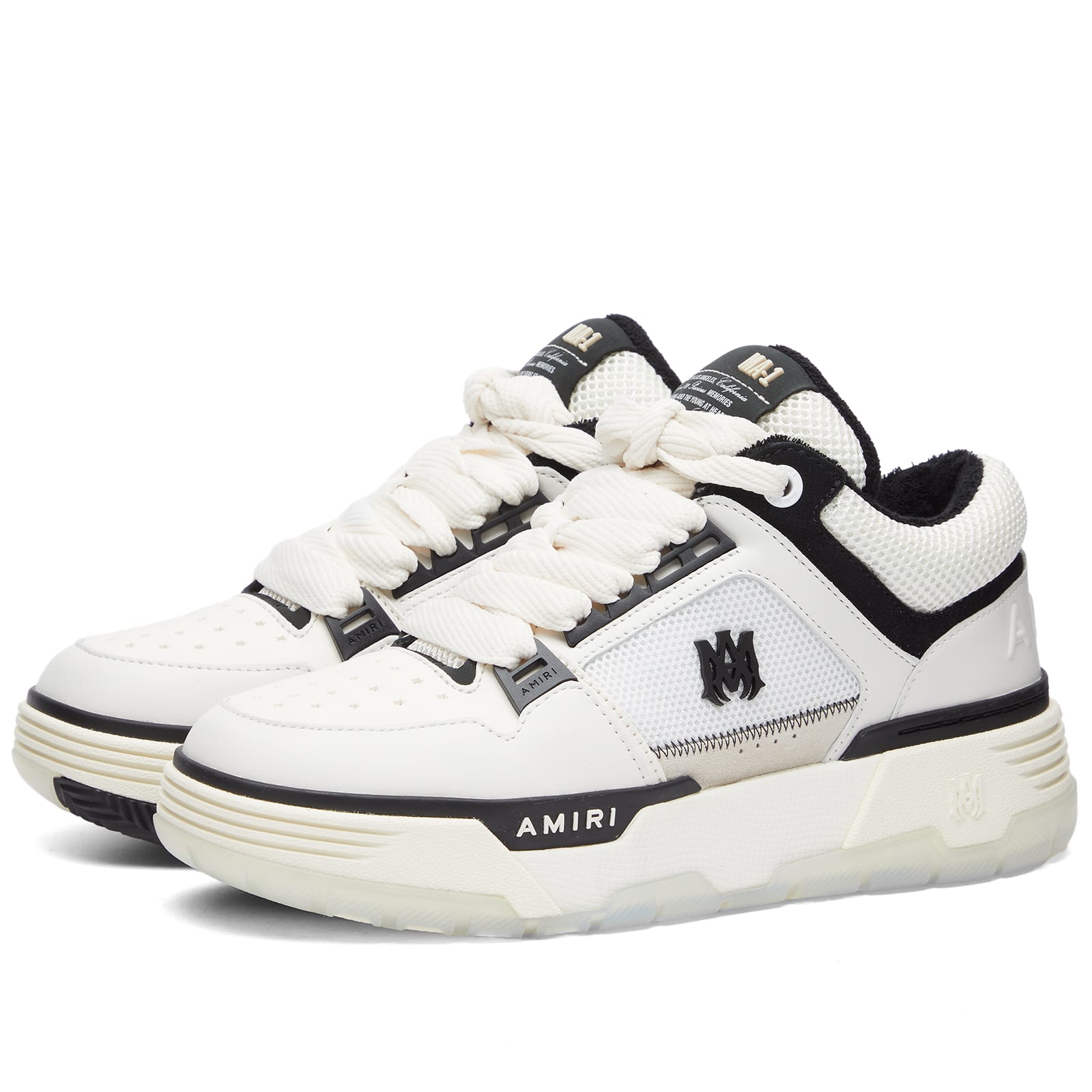
Footwear falls under denim, with heavy overlap into the hoodie band. The Skel Top Low, which the brand itself calls its house signature sneaker, is observed at $650 and anchors the category. Observed at $690 is the Skel Court Hi, a separate retro court silhouette on a canvas upper, and the MA-1 sneaker is observed at $799. That last name causes constant confusion, because MA-1 denotes a bomber jacket almost everywhere else in menswear while here it is a shoe. Taking the footwear line as a whole, observed listings start at roughly $420 for slip-ons and reach about $800 at the top. Note as well that the signature model’s pricing has drifted upward over time, given that resale records show it retailing at $590 at a release in August 2020, leaving any article that still quotes that figure as current out of date.
At the top: boots and worked outerwear
Above the core band comes anything built with substantial construction or hardware. The clearest observed marker is the Ryder Boot, listed between $1,090 and $1,290 depending on the material used for the upper. Outerwear runs higher again, with observed listings for varsity and heavily worked jackets falling roughly between $1,800 and $2,300, and reconstructed denim outerwear sitting inside the same territory. Flannel shirting, a founding pillar of the house rather than an afterthought, also reaches into the low four figures on the most worked pieces. These are the items where the price gap against the core band is easiest to justify in the hand, because leather sleeves, applied patches and studded or embellished panels all represent real labour. They are also the pieces most likely to be discounted deeply later in a season, which is covered further down.
Observed prices, gathered at a glance
The table pulls the individual figures cited above into one view for comparison. Every entry is an observed market price from 2026 listings rather than an official price, and each attaches to a specific named style rather than to a whole category. Ranges given elsewhere in this guide describe categories, so the two should not be read as the same kind of number. Look at how compressed the core band really is, with signature hoodie and signature sneaker sharing one figure. Note also that the distance from the entry point of core denim to its most visible style is under $350, which is narrow for a luxury range. Leaving the core band for boots and outerwear is where the steepest jumps happen, not inside it.
| Product | Band | Price observed |
|---|---|---|
| MA Core Logo Hoodie | Jersey piece | $650 |
| Skel Top Low | Sneaker | $650 |
| Skel Court Hi | Sneaker | $690 |
| Stack Jean | Core denim | $750 |
| MA-1 Sneaker | Footwear | $799 |
| Women’s Baggy MX3 | Denim, women’s | $990 |
| MX1 Jean | Denim | $1,090 |
| Ryder Boot | Boots | $1,090 to $1,290 by material |
Discounting is structural, not accidental
Any guide implying this brand never goes on sale is describing a different label. At authorised multi-brand retailers, observed in-season markdowns of 40 to 70 per cent appear, and past-season stock runs through the off-price arms of established department store groups at deeper cuts again. Legitimate goods through legitimate channels, in other words, with nothing suspect about buying them. That pattern also explains the secondary market, since a visible sale floor caps what buyers will pay elsewhere. Observed resale listings for standard core denim usually land well below the $1,090 figure attached to the MX1, while standard sneaker colourways rarely command sustained premiums. These are clothes to wear rather than assets, none of this is investment advice, and the observed pattern points firmly away from resale as a strategy.
When the price is itself the warning sign
Among the more reliable authenticity signals is price, so long as you know what a legitimate discount looks like. Real reductions live in the sale sections of named authorised retailers and their off-price arms, sit mostly in past-season stock, and never cover a whole catalogue at once. Sitewide cuts of 50 to 80 per cent covering every category including current season do not happen through authorised channels. That no brand outlet exists is settled, as AMIRI stated in a federal court complaint filed in July 2021 that it «does not have an AMIRI outlet store, nor has it ever authorized any person or business to operate such a store.» Anyone planning to buy amiri online should therefore treat outlet branding, self-declared official discount status and catalogue-wide markdowns as disqualifying rather than as a bargain. The safest route to fairly priced amiri clothing is still the brand’s own site, its boutiques, or a retailer named on its published stockist list.